


The AI job market has never been more exciting — or more confusing. Every week, a new model launches, a new tool goes viral, and another job description raises the bar impossibly higher. Students and early-career professionals are left asking:
what does it actually take to get hired in AI today?
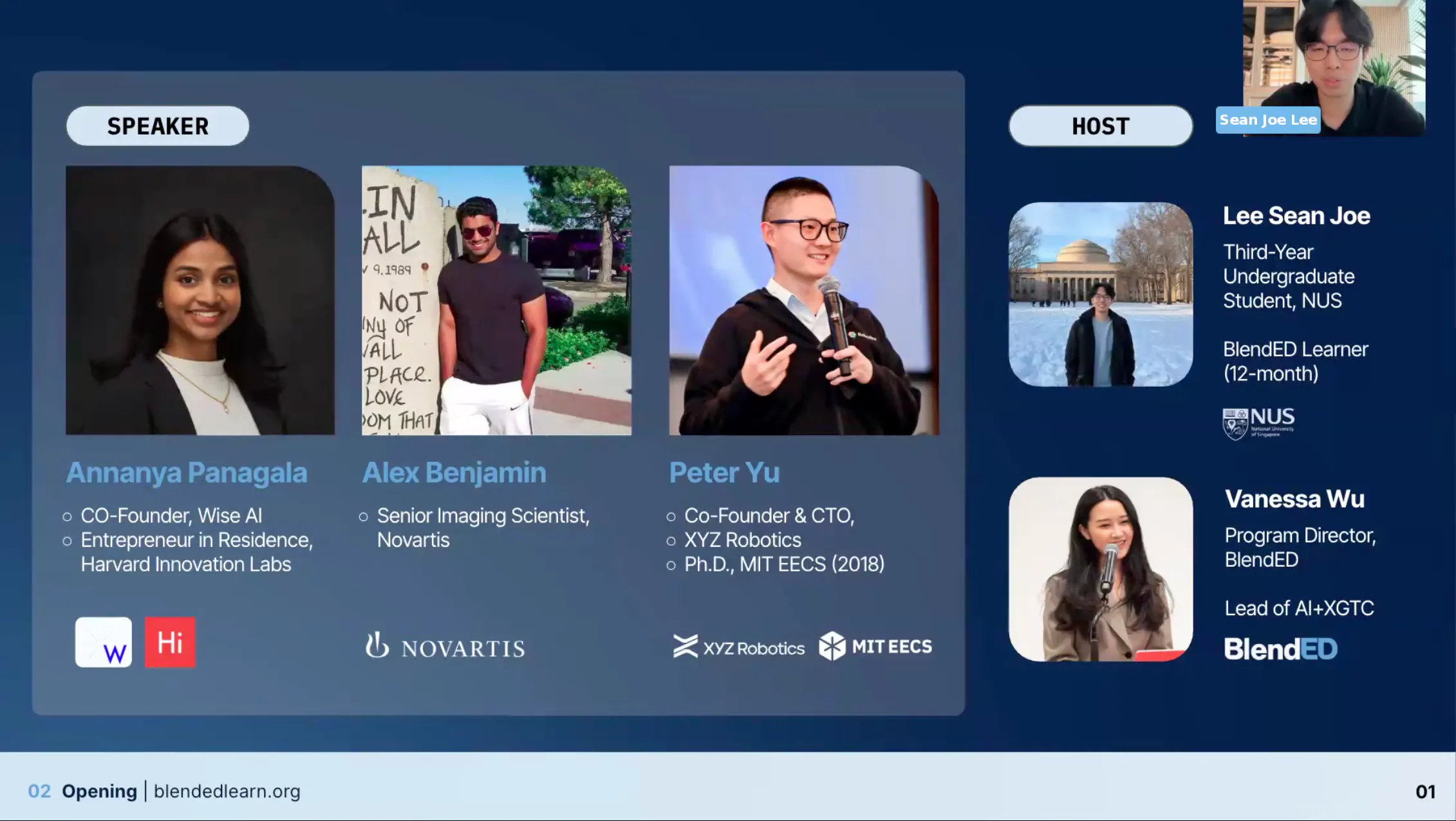
To find out, BlendED hosted a live panel — AI Hiring 2026: What MIT & Harvard AI Founders Look For — bringing together three builders from the MIT and Harvard ecosystem alongside a student representative from the National University of Singapore. The result was one of the most candid conversations we've had on the realities of AI hiring.
Here are the key insights.
1. "Entry-Level" Has Changed — But It Hasn't Disappeared
One of the most frequently asked questions from our student audience:
Is entry-level actually real anymore, or are companies quietly expecting mid-level performance from fresh graduates?
The short answer:
Entry-level still exists, but the definition has expanded.
Anya Panagala, co-founder and CEO of Wise AI, put it plainly — what once meant "recently graduated with some coursework" now means someone who has already built something real. Internships, side projects, open-source contributions, or even a high school app with real users all count. The youngest engineer on her team is 15.
Alex Benjamin, imaging scientist at Novartis and a former MIT PhD graduate, added an important nuance: most hiring decisions aren't really structured around "entry vs. senior" at all. They're driven by goodness of fit — a precise match between what a candidate can demonstrate and what the team actually needs.
Peter Yu, co-founder and CTO of XYZ Robotics, framed it around depth. The ability to identify a real challenge, articulate it clearly, and attempt a creative solution is what signals readiness, regardless of your title or graduation year.
Coding Is Table Stakes — Here's What Actually Differentiates Candidates
With AI making code generation faster and easier than ever, what actually separates a genuinely strong candidate from someone who just looks strong on paper?
All three panelists agreed: it's not more technical knowledge.
Alex pointed to first-principles problem solving as the most undervalued skill in the market. The ability to receive an ambiguous problem statement, break it into its fundamental components, consider risks and trade-offs, and think toward a solution is something you cannot fake, and you cannot speed-run.
Anya highlighted something equally critical: knowing how and where to learn. In a field where new tools launch every week, the candidate who can orient themselves quickly and implement new knowledge rapidly is far more valuable than one who knows every current tool by heart.
Peter rounded out the picture with communication. The ability to communicate precisely — to know your message, speak at the right level of abstraction for your audience, and make it easy for others to collaborate with you — is one of the most consistently underestimated skills in the industry.
Depth vs. Breadth: Know Which Path You're On
One thread that ran through the entire conversation:
Do you want to be a specialist or a leader?
In deep tech, specialists are sought after with laser precision. But if your ambition is leadership — managing teams, building products, founding companies — then breadth and narrative matter more. The practical takeaway: get clear on which path you're building toward, and let that guide which experiences, projects, and courses you pursue.
For Students: Enjoy Your 20s, But Make the Investment
Alex said plainly that many job descriptions today are "completely absurd," and holds hiring managers partly responsible. Students should not read the market as a signal that they need to simulate a decade of professional life during their undergrad years.
What they should do is balance depth with exploration. All three agreed: your 20s are a gift. The goal is to make real investments in your craft while staying curious, maintaining social capital, and enjoying the freedom that won't always be there.
Starting a Company? Solve a Real Problem First
The only startups worth starting are those solving a real, observable problem — not a problem you invented to justify founding something. Alex, who co-founded two companies that both failed, was direct: a business solves a problem and asks for money in return. If you think you've found a real problem you can monetize, that's the point at which you should form a company.
Watch the recording ↓
Passcode: VycF*Z8m
About BlendED
This webinar was hosted by BlendED, an AI education platform based in Kendall Square, Boston — right next to MIT. Our mission is to help students from all backgrounds, STEM and non-STEM alike, build genuine AI foundations through real-world projects with founders, researchers, and industry experts in the Boston AI ecosystem.
Through our AI+X Learning Plan (6 or 12 months), students gain hands-on project experience, industry mentorship, and the kind of validation that actually shows up on a portfolio — not just a certificate.
We've connected over 120 student clubs across 6 countries and co-founded the AI Plus X Global Talent Community with students from around the world. Events like this one are just a part of what we offer — virtual and in-person programming throughout the year, covering everything from AI foundations to NLP to applied machine learning.
If you're serious about positioning yourself in the AI industry over the next 12 months, start building — and let BlendED help you do it.
👉 Explore the BlendED program catalog | Join our next event | Connect with our team