


As artificial intelligence continues to advance, its real-world impact increasingly depends on how well it integrates with physical systems. In this AI+X Global Talent Community workshop, “AI in Hardware: Building Smarter Systems from Chips to Robots,” participants explored how AI moves beyond software—into chips, sensors, wearables, and autonomous machines that interact directly with the world around us.
The session was led by Robin Singh, Optical Scientist and AI & Hardware Researcher (Ph.D. and M.S. from MIT), who brings experience spanning academic research and industry applications in AI-driven hardware systems, AR/VR devices, and autonomous technologies.
Why AI in Hardware—and Why Now?
The workshop opened with a fundamental question: Why does AI need hardware to truly matter?
While AI models are becoming increasingly powerful, they only become real products when embedded into physical systems that operate under real-world constraints.
Robin emphasized that AI is “only as good as its hardware.” Power limits, latency requirements, thermal constraints, and form factors fundamentally shape what AI systems can do in practice. Understanding AI in isolation is no longer enough—successful innovation requires co-designing AI and hardware together.
Three Domains Where AI Meets the Physical World
The session focused on three major domains that demonstrate how AI and hardware converge in real products:
Wearables and AR/VR Systems
Using AR/VR smart glasses as a primary example, Robin walked through how AI operates on edge devices. Participants learned about system-on-chip (SoC) architectures, sensor stacks, and edge computing, as well as the strict power and latency constraints that govern wearable AI systems. Topics such as perception, gesture and eye tracking, voice interaction, and intelligent rendering highlighted how AI must be carefully optimized to run in real time on small, battery-powered devices.
AI for Chip Design
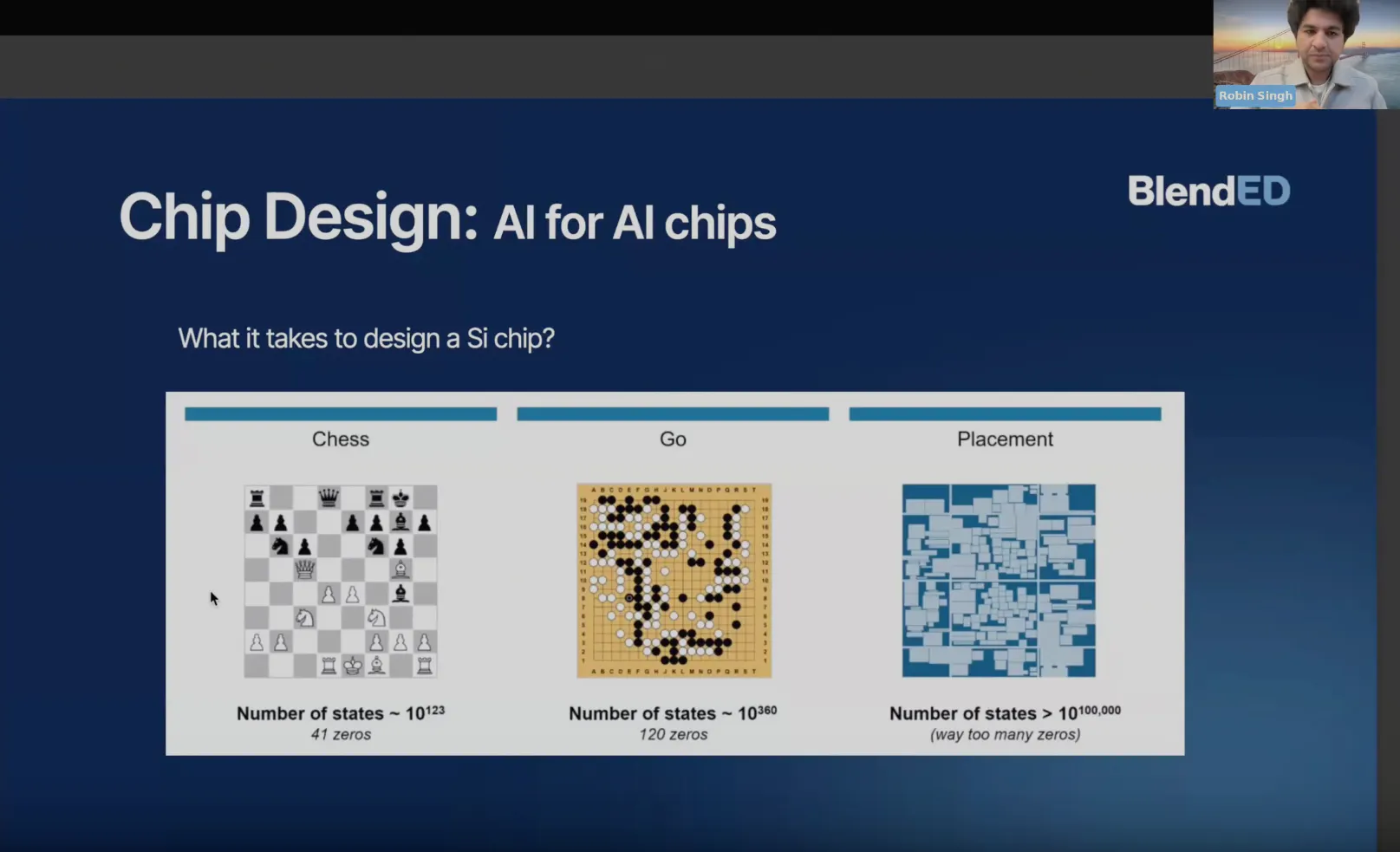
The workshop then moved down to the silicon level, exploring how AI is increasingly used to design AI chips themselves. From architectural exploration and RTL optimization to placement, routing, and manufacturability, AI techniques such as reinforcement learning, graph neural networks, and generative models are transforming the chip design process. Rather than replacing human engineers, AI acts as a co-designer—helping navigate the massive design space of modern chips.
Autonomous Vehicles as Cyber-Physical Systems
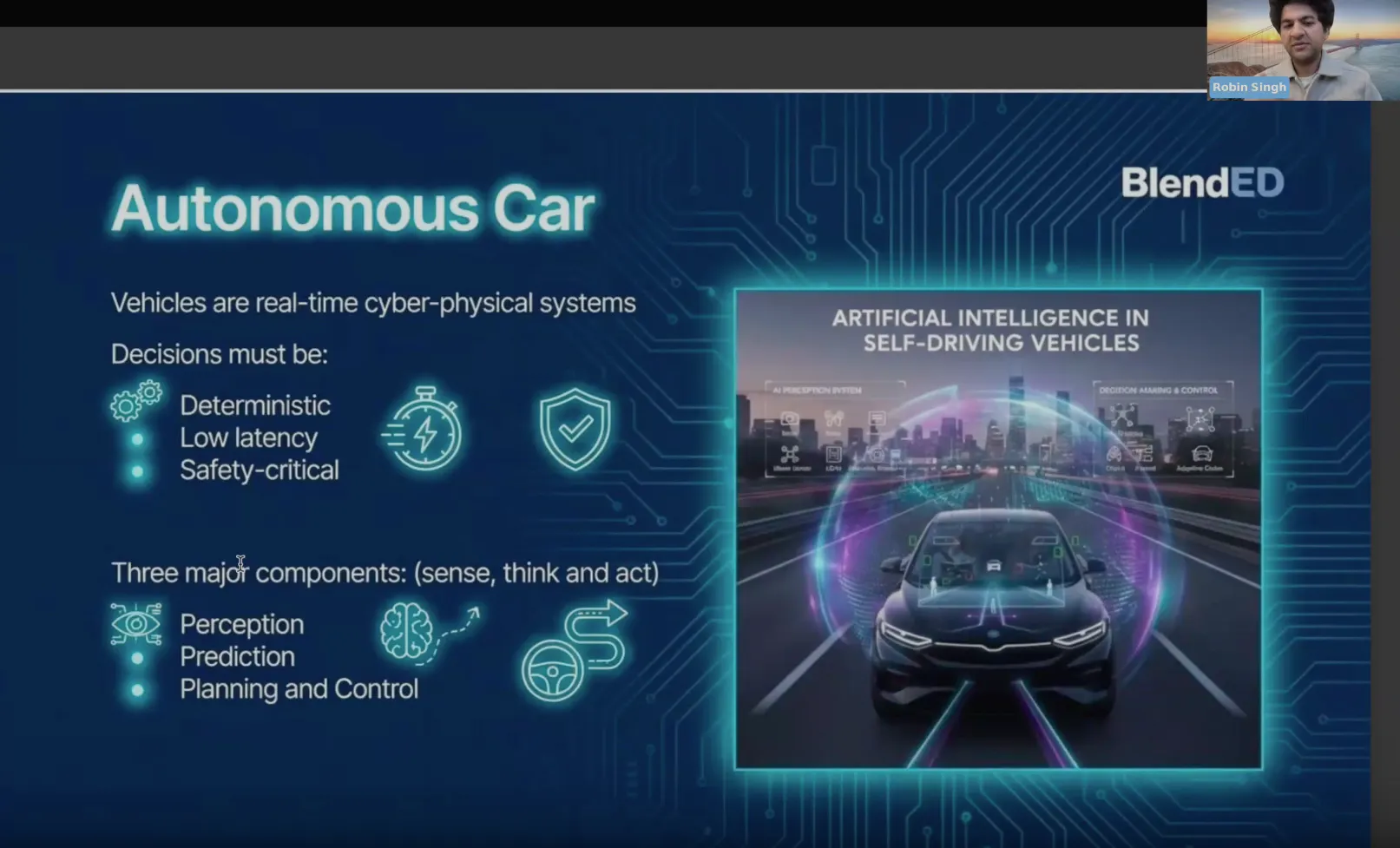
The third domain examined autonomous driving as a large-scale, safety-critical AI system. Robin explained how self-driving cars rely on perception, prediction, and planning pipelines that must operate under extremely low latency and high reliability constraints. Participants gained insight into how custom hardware accelerators and optimized AI models are essential for enabling real-time decision-making in autonomous vehicles.
From Concepts to Hands-On System Design
Beyond theory, the workshop highlighted how these ideas translate into hands-on learning through the AI in Hardware Project-Based Learning (PBL) track. In this project, students work in simulated environments that closely mirror real hardware systems, allowing them to:
Design AR/VR systems under realistic power and latency constraints
Build and optimize custom chip architectures using AI-assisted tools
Develop autonomous driving pipelines in simulation platforms
This approach allows learners to engage directly with the challenges engineers face when deploying AI in the real world—even without access to physical hardware.
Key Takeaways
This workshop reinforced a critical insight: AI innovation does not happen in isolation from hardware. Real impact comes from understanding how algorithms, systems, and physical constraints interact as a whole. By learning to design AI with hardware in mind, students gain skills that are increasingly essential for careers in AI research, hardware engineering, robotics, and intelligent systems.
As AI continues to move into everyday devices and infrastructure, the ability to build intelligent systems that operate reliably in the real world will define the next generation of innovation.
Related Learning Opportunity|AI in Hardware (Mar. 09 - May 03, 2026)
In early 2026, Robin Singh will lead a hands-on, project-based AI in Hardware track within the AI+X Learning Plan. This experience focuses on designing AI systems that operate under real-world hardware constraints.
Project tracks include:
Wearable & AR/VR Systems – Edge AI design under power, latency, and form-factor limits
AI for Chip Design – Using AI models to assist architecture exploration and physical design
Autonomous Systems – Perception, prediction, and planning in simulated self-driving environments
Students work in simulation-based environments and build portfolio-ready projects, gaining practical experience in AI–hardware co-design.
Join the AI+X Community
Become part of a global network of learners exploring AI in biology, engineering, business, hardware, and more.
Join our future AI+X workshops
Create your free GTC account to stay updated on global events
Explore upcoming PBL projects, including AI & Cybersecurity
Visit us in Boston for the 2026 Winter or Summer AI+X On-Campus Experience
📺 Watch the Replay
Couldn’t join live? Don’t miss this in-depth discussion and Q&A.